
Do Cutting Discs Have an Expiry Date? Debunking Myths and Understanding Real Risks
The sight of a dusty, forgotten cutting disc tucked away in a workshop corner inevitably raises the question: “Is this still safe to use?” Unlike a carton of milk, cutting discs rarely sport a printed “Use By” date. This absence leads to confusion, myths, and potentially dangerous assumptions. So, do cutting discs truly have an expiry date? The answer is nuanced: While they don’t have a mandated calendar-based expiration date like food or medicine, they absolutely have a finite effective shelf life dictated by material degradation and storage conditions. Using an aged or improperly stored disc poses significant safety risks.
The Myth of the Regulatory Expiry Date

Let’s dispel a common misconception upfront. Reputable standards organizations governing abrasive safety, such as OSHA (Occupational Safety and Health Administration) in the US, the European Standard EN 12413, or the FEPA (Federation of European Producers of Abrasives) standard, do not mandate a specific calendar expiry date for resinoid bonded cutting discs (the most common type). Their focus is on:
Manufacturing Standards: Ensuring discs are produced to withstand specified operating speeds (marked by the RPM rating) and mechanical stresses.
Testing Requirements: Mandating rigorous tests for bursting speed, mechanical strength, and impact resistance at the time of manufacture.
Usage Guidelines: Providing rules for proper handling, mounting, and operation to minimize risk.
The absence of a regulatory expiry date stems from the understanding that a disc’s lifespan is primarily determined by how it is stored and handled after manufacture, not merely the passage of time.
The Reality: Degradation Mechanisms Dictating “Expiry”
While not expiring on a fixed date, cutting discs are susceptible to several degradation processes that effectively render them unsafe or unusable over time. Think of this as their functional expiry:
Resin Binder Degradation (The Core Issue):
The Chemistry: Cutting discs rely on a phenolic or similar resin binder to hold the abrasive grains (usually aluminum oxide or silicon carbide) and reinforcing materials (often fiberglass mesh) together. This resin is a thermosetting polymer.
The Aging Process: Over time, even under ideal conditions, the resin undergoes a slow, continuous process called post-curing or age-hardening. This involves further cross-linking of polymer chains. While this might sound like strengthening, it actually makes the resin more brittle.
The Consequence: Increased brittleness drastically reduces the disc’s ability to absorb impact and flexural stresses during use. A brittle disc is far more prone to shattering or exploding under load, especially during side forces or jamming. Research by abrasives manufacturers (e.g., studies cited by Saint-Gobain Abrasives and 3M) consistently shows a measurable decrease in impact strength and flexural strength in resin bonds over periods as short as 1-3 years, accelerating significantly under poor storage.
Visual Clues: Severe aging can manifest as a pronounced darkening of the resin (beyond its normal color), excessive powdery residue on the disc surface, or visible micro-cracks.
Moisture Absorption(The Silent Killer):
The Vulnerability: Phenolic resins are hygroscopic to some degree, meaning they can absorb moisture from the air.
The Damage: Absorbed moisture weakens the critical bond between the resin and the abrasive grains and the reinforcing fibers. This dramatically reduces the disc’s tensile strength and cohesion. Studies by the German Abrasives Association (FEPA member) have demonstrated that moisture absorption equivalent to just 0.5% of the disc’s weight can reduce its strength by up to 30%.
The Consequence: Moisture-weakened discs are highly susceptible to delamination (layers separating), catastrophic disintegration during use, or simply crumbling when pressure is applied. This is arguably the most common cause of “expired” disc failure.
Visual Clues: Warping, a “spongy” feel, visible separation of layers, or rust staining on the fiberglass mesh or center plate.
Extreme Temperature Fluctuations:
The Stress: Repeated cycles of heating and cooling (e.g., discs stored in uninsulated sheds experiencing hot days and cold nights) cause the different materials in the disc (resin, abrasive grain, fiberglass, metal center) to expand and contract at different rates.
The Consequence: This differential expansion/contraction induces internal stresses and can lead to micro-cracking within the resin bond or at the interfaces between materials. These micro-cracks become failure initiation points under operational stress.
Visual Clues: May not be obvious externally until failure occurs.
Physical Damage and Improper Handling:
The Impact: Dropping discs, stacking them improperly (leading to warping), or storing them where they can be impacted by other objects can cause cracks, chips, or damage to the fiberglass reinforcement or center hole.
The Consequence: Any physical flaw acts as a stress concentrator, significantly increasing the likelihood of the disc breaking apart during rotation, often violently.
Visual Clues: Visible cracks, chips, nicks, damaged fiberglass mesh, bent center plates, or warping.
The “Shelf Life” Guidance from Manufacturers

Recognizing these degradation risks, responsible manufacturers do provide recommended shelf life guidelines, usually found in technical data sheets (TDS) or material safety data sheets (MSDS/SDS), rather than printed on the disc label itself. This is a crucial distinction from a regulatory expiry date.
Typical Recommendations: Most major manufacturers (Norton Abrasives, Walter Surface Technologies, Pferd, Tyrolit, Bosch) advise a maximum shelf life of 2 to 3 years from the date of manufacture, provided optimal storage conditions are strictly maintained.
The Storage Imperative: This timeframe is heavily conditional. The “clock” ticks faster, much faster, if discs are exposed to moisture, heat, cold, or physical abuse. A disc stored poorly for 6 months might be far more degraded than one stored perfectly for 2 years.
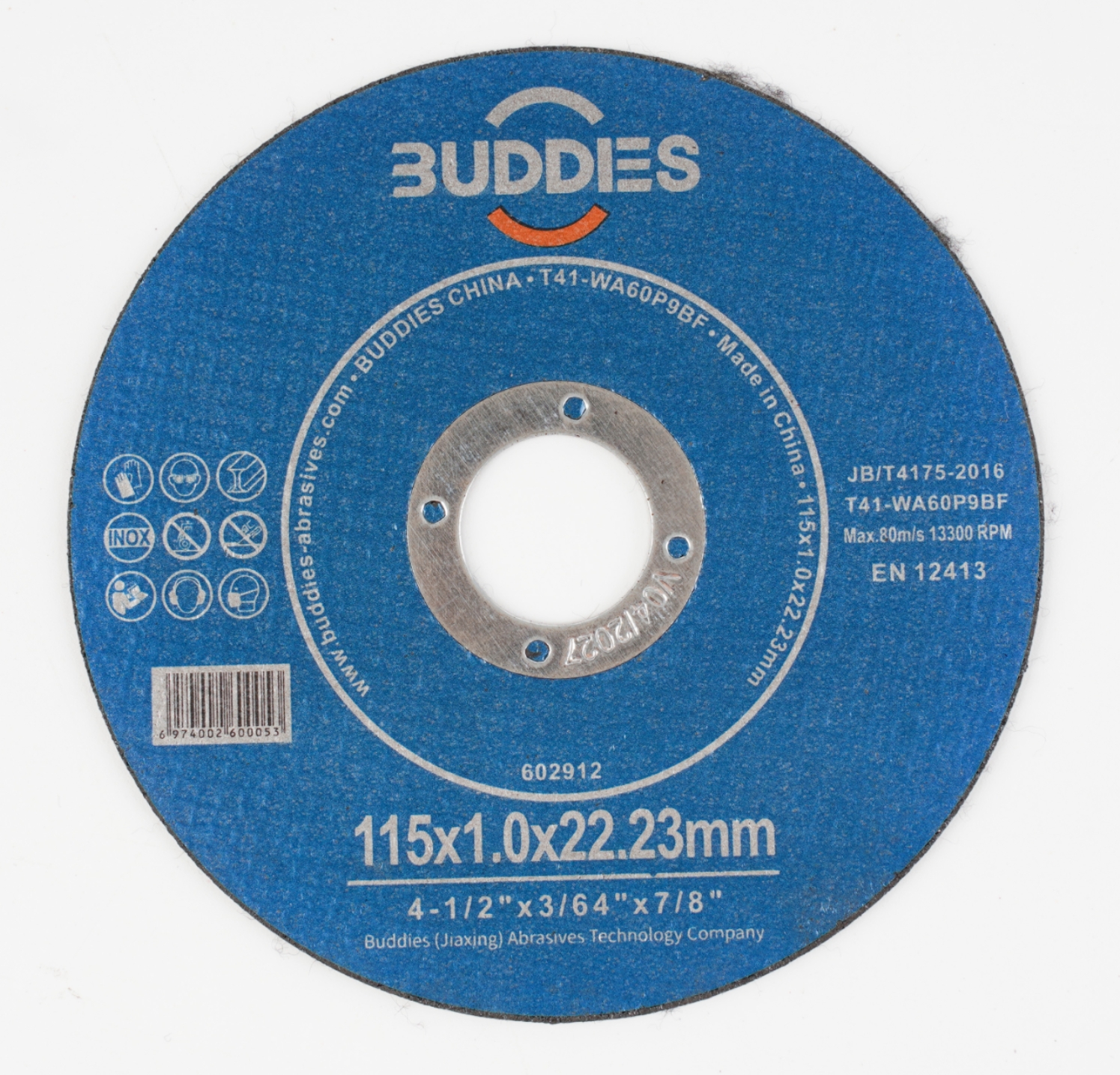
Manufacturing Date Coding: Discs are typically marked with a date code (e.g., a batch number, Julian date, or specific month/year code). Understanding this code (often explained on the manufacturer’s website or packaging) is essential for tracking age. Always check for this code upon receipt.
The Critical Role of Storage: Extending Functional Life


Proper storage is the single most significant factor in maximizing the safe usable life of a cutting disc:
Control Humidity: Store discs in a cool, dry place with relative humidity ideally below 65%. Climate-controlled storage is best. Avoid damp basements, uninsulated sheds, or areas near water sources.
Stable Temperatures: Avoid extremes of heat and cold. Aim for temperatures between 10°C (50°F) and 25°C (77°F). Never store near radiators, ovens, or in direct sunlight.
Original Packaging: Keep discs in their original, unopened packaging until ready for use. This packaging is designed to offer some protection from moisture and physical damage. Reseal opened packages tightly.
Moisture Barriers: For long-term storage or in humid environments, place discs (in their packaging) inside sealed plastic bags with desiccant packs (silica gel) to absorb any moisture.
Proper Stacking: Store discs flat, never on edge. Avoid stacking excessive weight on top of them to prevent warping or crushing. Use manufacturer-supplied dividers if provided.
Handling: Always handle discs carefully to avoid dropping or impacting them.
The Non-Negotiable: Pre-Use Inspection – Your Ultimate Safety Check

Regardless of the disc’s age or apparent storage conditions, a thorough visual and tactile inspection is mandatory before every single mounting. This is your personal “expiry date” check. Reject any disc showing:
Cracks or Chips: Any visible crack, however small, in the abrasive material, the fiberglass mesh, or the resin bond, especially radiating from the center hole or the periphery. Run your fingernail gently over the surface; feel for hairline cracks.
Warping: Lay the disc on a flat surface. It should sit flat without rocking. Any noticeable warp indicates internal stress or damage.
Damage to Reinforcement: Broken or frayed fiberglass mesh strands, or damage to the metal center plate (if applicable).
Excessive Aging Signs: Severe darkening, powdery residue, or a generally “dried-out” and brittle appearance/feel.
Moisture Damage: Warping, a spongy feel, visible water stains, rust on metal components, or separation of layers.
Expired Manufacturer’s Stated Shelf Life: If you know the manufacturing date and it exceeds the manufacturer’s recommended shelf life (typically 3 years), and especially if storage conditions were anything less than perfect, do not use it. The degradation risks are too high.
Consequences of Ignoring Functional Expiry: It’s Not Worth the Risk

Using an aged, degraded, or damaged cutting disc isn’t just about poor performance (reduced cutting speed, quicker wear); it’s a severe safety hazard:
Catastrophic Failure: The primary risk is the disc shattering or exploding during rotation. High-speed fragments become lethal projectiles.
Delamination: Layers separating can cause large chunks to break off violently.
Reduced Strength: A weakened disc may simply disintegrate under normal cutting pressure.
Kickback: A failing disc can grab the workpiece violently, causing the tool to jerk back towards the operator.
Operator and Bystander Injury: Flying fragments and debris can cause severe lacerations, eye injuries (even through safety glasses in extreme cases), and blunt force trauma. Fatalities, while rare, have occurred.
Property Damage: Fragments can damage equipment, vehicles, or structures.
Case studies from organizations like the UK’s HSE (Health and Safety Executive) and OSHA often cite failures linked to aged or poorly stored discs as contributory factors in workshop accidents.
Conclusion: Functional Expiry Trumps Calendar Dates
Cutting discs do not expire on a pre-ordained calendar date mandated by safety regulators. However, they are consumable products with materials (especially the resin binder) that degrade over time due to chemical aging, moisture absorption, temperature extremes, and physical damage. This degradation imposes a functional expiry – the point at which the disc can no longer be trusted to perform safely under operational stresses.
The manufacturer’s recommended shelf life (typically 2-3 years under ideal conditions) is a crucial guideline, not a guarantee. Optimal storage (cool, dry, stable) is paramount to approach this timeframe safely. Most critically, a rigorous visual and tactile inspection by the user before every single use is the ultimate and non-negotiable safety measure.
Never gamble with a disc showing signs of age, damage, or questionable storage history. The potential consequences of failure are too severe. When in doubt, throw it out. The cost of a new disc is insignificant compared to the value of your safety and well-being. Treat your cutting discs with respect, store them meticulously, inspect them relentlessly, and retire them promptly when their functional life is over. This disciplined approach is the cornerstone of safe grinding and cutting operations.
This post is also available in:


Leave a Reply
Want to join the discussion?Feel free to contribute!