
The Essential Guide to Backing Fabrics: Crafting Superior Sanding Belts for Precision Grinding
In the world of abrasive tools, sanding belts stand out as versatile workhorses for everything from metal polishing to woodworking. But what makes these belts durable, flexible, and efficient under intense pressure? The answer lies in their backbone: the backing fabric. Often overlooked, this foundational material determines how well a belt performs during cutting, grinding, or finishing tasks. As a leading exporter of cutting discs, grinding wheels, sanding belts, sandpaper, and angle grinder accessories, we’ve seen firsthand how the right backing fabric can elevate product quality and customer satisfaction.
This guide dives into the characteristics of backing fabrics used in coated abrasives like sanding belts. We’ll explore material types, historical innovations, key performance factors, and practical selection criteria. Whether you’re a manufacturer optimizing production or a buyer sourcing reliable tools, understanding these elements ensures you get the most from your abrasives. Let’s break it down step by step.

Why Backing Fabrics Matter in Sanding Belts
Backing fabrics provide the structural support for abrasive grains in sanding belts. Unlike rigid bases, these fabrics offer flexibility, allowing the belt to conform to curved surfaces without cracking or tearing. They must withstand high tensile forces, resist heat from friction, and bond seamlessly with adhesives and grains.
Common materials include cotton, polyester, and blends like cotton-polyester mixes. Cotton remains the go-to for its affordability and ease of processing, while synthetics address limitations like poor water resistance. The choice depends on the application: heavy-duty belts for industrial grinding favor robust polyester, while lighter polishing tasks suit cotton.
Globally, backing fabrics vary by weight and weave to match grit sizes and workloads. Heavier fabrics excel in coarse grits and aggressive sanding, distributing force evenly to prevent premature wear. Lighter ones shine in fine grits, offering a smoother finish without excessive flex. Standards differ by region—U.S. manufacturers might classify by grams per square meter (gsm), while European norms focus on tensile strength—but the principle is universal: match the fabric to the job for optimal longevity and efficiency.
Evolution of Backing Fabrics: From Cotton Classics to Synthetic Powerhouses
Cotton has dominated backing fabrics since the early days of coated abrasives, thanks to its natural advantages. Sourced abundantly and cost-effectively, cotton cloths provide a smooth, even surface that bonds well with resins, glues, and grains. Their high flexibility prevents buckling during belt flexing, and they offer solid tensile strength with minimal elongation under load.
However, cotton’s drawbacks—such as lower water and heat resistance—spurred innovation. In the 1960s, the U.S. pioneered nylon-based sanding belts, branded as Microlon, which boosted grinding efficiency by about 20 times compared to traditional cotton versions. This leap came from nylon’s superior durability in wet conditions and high-speed operations.
By the 1970s, polyester fabrics emerged as a game-changer. With higher tensile strength, lower stretch rates, and better resistance to heat and moisture, polyester enabled heavier-duty belts for demanding applications like aerospace part finishing or automotive metalworking. Norton Company’s polyester-backed belts quickly gained traction worldwide, sparking rapid adoption.
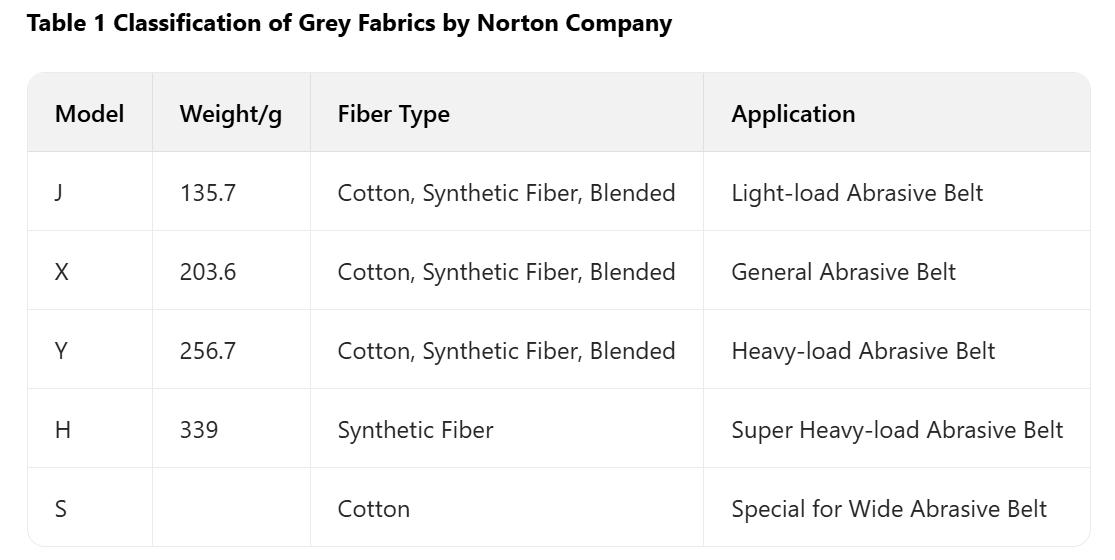
Today, polyester accounts for 7-8% of backing fabrics in coated abrasives across developed markets, with the U.S. reaching 13.5% as early as 1981—a figure that’s continued to climb (source: Industry reports from the Coated Abrasives Manufacturers’ Institute, 1982). Blends, particularly cotton-polyester mixes introduced via Japanese and Korean technologies in the late 1990s, have surged in popularity in China and beyond. These hybrids combine cotton’s processability with polyester’s toughness, offering thick, flat weaves at competitive prices.
To illustrate the upgrade, consider physical properties from 3M Company’s data on cotton versus polyester backings:
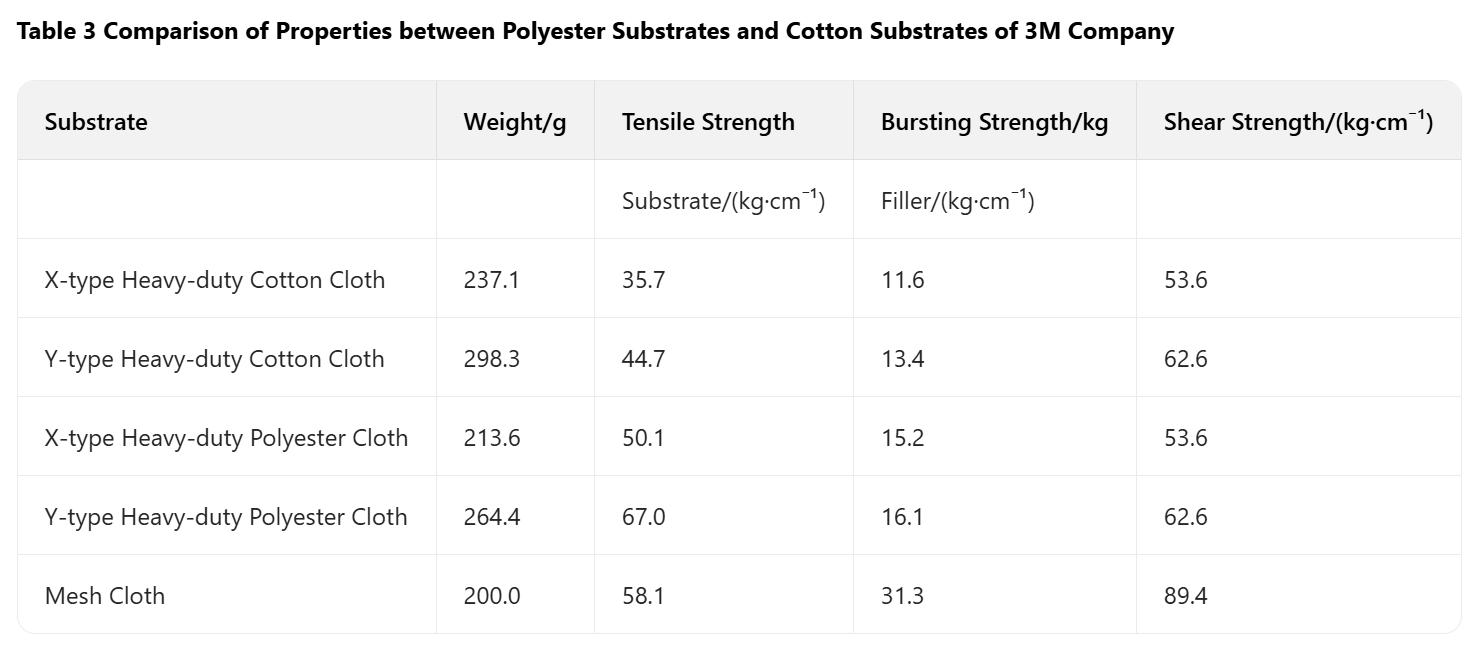
These metrics highlight why polyester dominates high-load scenarios: less stretch means precise control, while low water uptake prevents delamination in damp environments.
Key Requirements for High-Quality Backing Fabrics
Selecting the right backing isn’t guesswork—it’s guided by precise specs tailored to sanding belt performance. Here’s what to prioritize:
1. Fiber Type: Balancing Strength and Compatibility
Cotton reigns supreme for 80-90% of coated abrasives due to its bonding prowess with diverse adhesives, flat surface for uniform grain coating, high strength with low stretch, and low cost. It’s ideal for standard dry sanding.
Synthetic options like nylon or polyester step in for specialized needs. They boast smoother surfaces and unmatched strength but can elongate more and demand selective adhesives—animal glues, for instance, don’t adhere well to synthetics. Advances in pre-treatment, such as high-temperature stretching, have minimized these issues, making polyester a staple for waterproof belts.
Cotton-polyester blends address mixed demands: the cotton aids adhesion, while polyester boosts durability. In China, these have proliferated since the 2000s, but processing them requires dual-treatment methods to handle differing fiber affinities—cotton needs saturation for glue uptake, polyester favors surface activation.
2.Cotton Blending and Quality
For cotton-dominant fabrics, fiber quality is non-negotiable. Premium long-staple cotton—fine, mature, and impurity-free—yields denser, whiter, stronger cloths with minimal knots. This translates to belts that resist tearing during aggressive use.
In blends, fiber ratios matter: a 60/40 cotton-polyester mix might optimize cost and strength, but ratios must align with end-use. Poor blending leads to uneven wear, so rigorous testing is essential.
3.Weight Classification: Tailored to Grit and Task
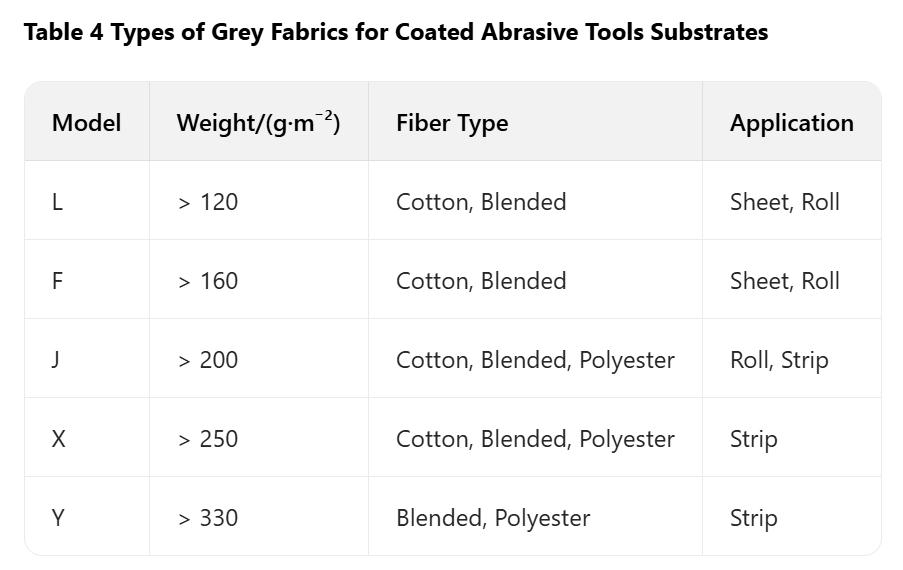
Just like paper backings, fabric weights are graded for specific roles. Heavier weights (e.g., 300-500 gsm) suit coarse grits (16-60) in power grinding, absorbing shock without fraying. Lighter ones (150-250 gsm) fit fine grits (120+) for polishing, ensuring flexibility without sagging.
Classifications vary: U.S. standards might use “J” for medium-heavy (per FEPA norms), while others reference ISO weights. For sheet abrasives, lighter fabrics suffice; belts demand heavier ones for tear resistance. Always consult manufacturer charts for exact matches.
4.Weave Structure and Yarn Count
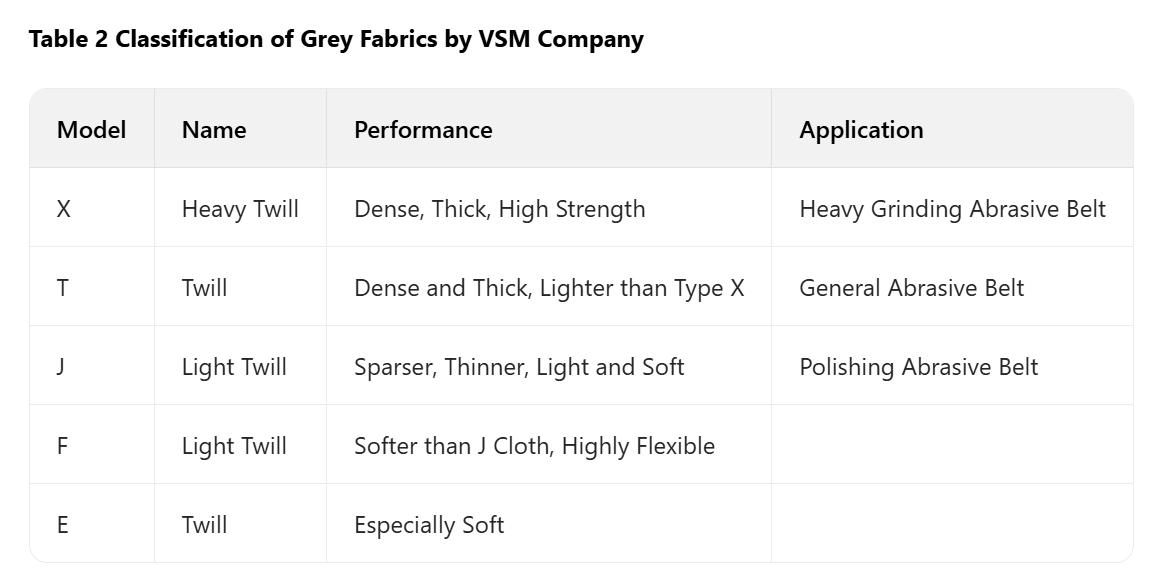
Twill weaves dominate for their balance of thickness, softness, and strength—perfect for embedding grains without compromising flex. Finer twills (higher yarn counts, thinner yarns) produce sleek surfaces for fine-grit belts, ideal for mirror finishes on metals.
Coarser twills (lower counts, thicker yarns) handle rough sanding, providing bulk for durability. Plain weaves occasionally appear in ultra-fine applications for their flatness, aiding polishing on delicate substrates like composites.
5.Density, Strength, and Elongation: The Performance Trifecta
Optimal density strikes a middle ground: too dense, and the fabric stiffens, hindering glue penetration; too loose, and it weakens, soaking up excess adhesive. Aim for balanced weaves that maintain softness alongside robustness.
A high warp density with lower weft promotes radial strength for belt tensioning, while easier weft tearing simplifies sizing in production. Low elongation (under 10%) is crucial—stretchy fabrics distort under load, leading to uneven abrasion and belt failure.
BUDDIES Professional Perspective: The Engineering Wisdom of Backing Material Selection
At BUDDIES, we firmly believe in the industry truth that “the backing sets the ceiling, while abrasives unlock the performance.” Our technical team recommends:
- For standard metalworking and woodworking, premium twill cotton fabrics deliver dependable solutions with excellent flexibility and cost-effectiveness.
- In humid environments or coolant-heavy operations, polyester backings exhibit superior stability, resisting delamination and maintaining integrity.
- For heavy-duty grinding and high-volume production, advanced synthetic fiber backings guarantee efficiency, minimizing downtime and maximizing throughput.
We uphold rigorous supplier vetting and incoming inspections to ensure every roll of sanding belt backing meets our performance benchmarks. Our experts are always on hand to offer tailored backing selection advice, helping you match the ideal sanding belt to your specific workpiece materials, machinery setups, and precision needs. Partner with BUDDIES today—let’s engineer your next breakthrough in abrasive performance.
This post is also available in:


Leave a Reply
Want to join the discussion?Feel free to contribute!