
Same Grit, Different Results: Why Abrasive Grain Type Matters
When buyers compare sanding belts, abrasive paper or fiber discs, grit size is usually one of the first specifications they check. Three products may both be marked P80, yet one cuts faster, another lasts longer, and a third produces a cooler, more uniform finish.
The reason is simple: grit size describes the approximate particle-size range, but it does not fully describe abrasive performance. Under the FEPA system, coated abrasives normally use P-grit designations, while bonded abrasives use F-grit designations. P80 therefore indicates an approximate particle-size range, but not how the grains fracture or how long they remain sharp.
Why the Same Grit Can Behave Differently
Each abrasive grain works like a very small cutting tool. During sanding or grinding, its cutting edges gradually become dull, fracture or pull away from the bond.
Different aluminium oxide grains have different chemical compositions, crystal structures, toughness and friability. These properties affect cutting speed, heat generation, useful life and finish consistency. FEPA also notes that abrasive grains vary by chemistry, particle size, grain shape and special treatment.
Friability is especially important. A friable grain breaks down more easily and exposes fresh cutting edges. This can improve cutting efficiency, but excessive fracture may shorten service life. A tougher grain may last longer, but can become dull if it does not renew its cutting edges.
The best choice is therefore not always the hardest or most expensive grain. It is the grain that matches the workpiece, machine power, pressure and required finish.
Brown and Heat-Treated Aluminium Oxide
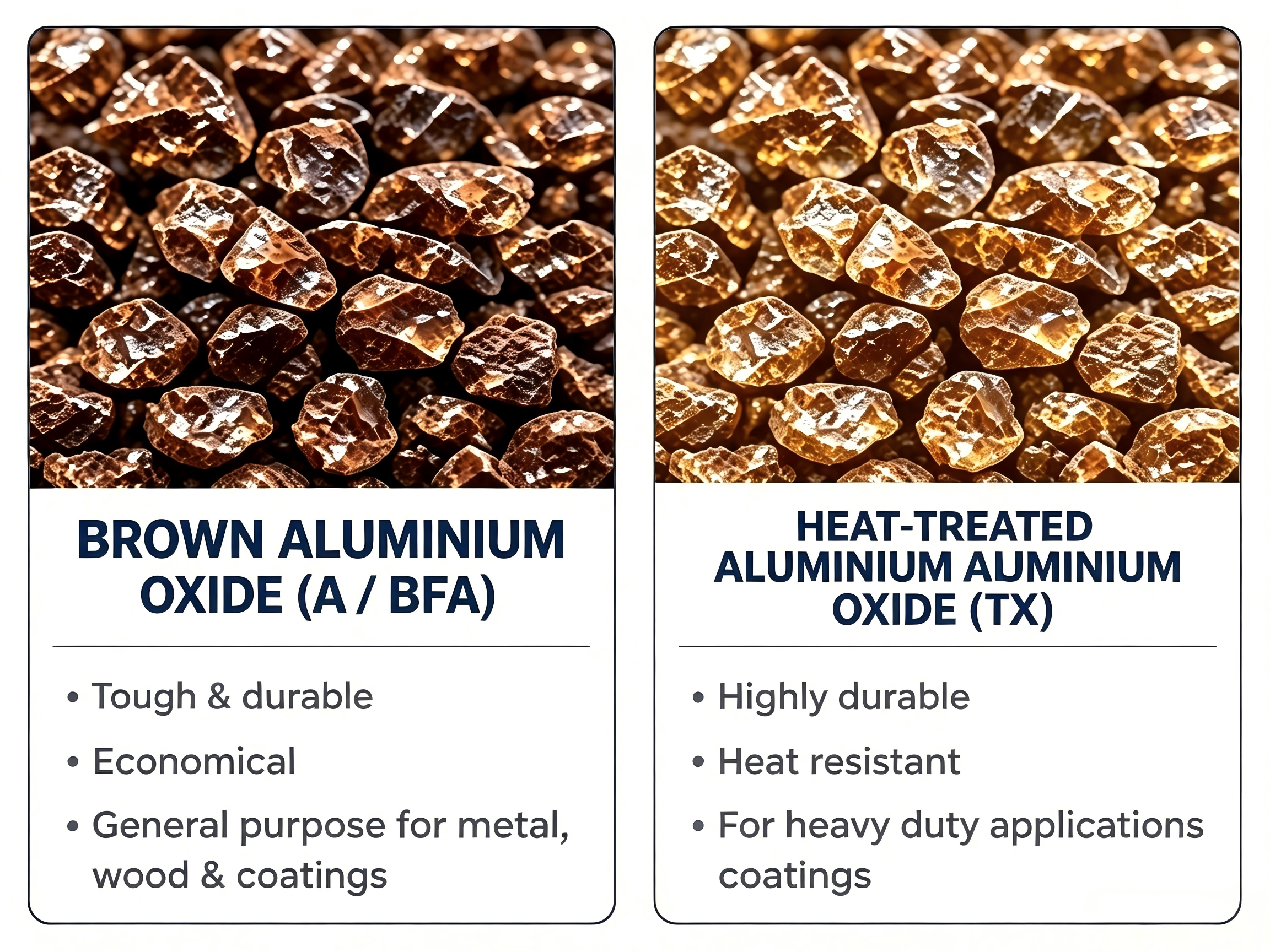
Brown fused aluminium oxide is widely used because it offers a practical balance of hardness, toughness, durability and cost. It is suitable for general-purpose sanding and grinding of steel, wood and coatings.
At the same P80 grit, brown aluminium oxide often provides stable, economical performance, although the final result still depends on grain shape, coating density, bond and backing.
Heat-treated aluminium oxide is usually an aluminium oxide grain that has received additional thermal treatment and, in some products, a surface coating. These treatments can improve grain stability, toughness and bonding with resin, making the grain suitable for demanding coated abrasives such as heavy-duty belts and discs. Official product data from abrasive-grain manufacturers also show that heat treatment and surface coatings may be used to improve grit stability and resin adhesion.
Treatment methods vary, so the complete product construction still matters.
White and Semi-Friable Aluminium Oxide
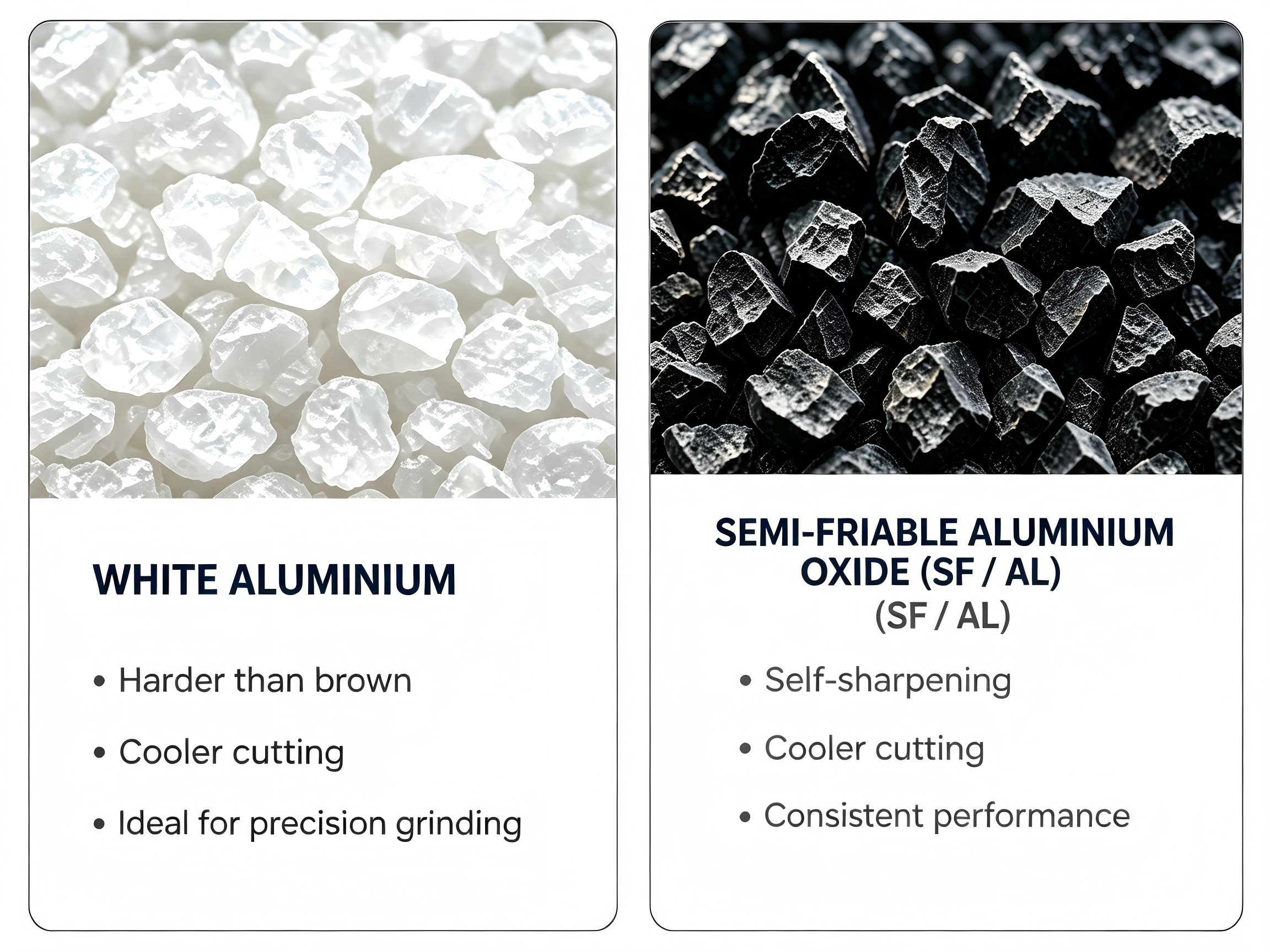
White fused aluminium oxide is made from calcined alumina and has high purity. Compared with tougher brown aluminium oxide, it is generally more friable and can expose fresh cutting edges more readily.
This makes it useful where a sharper cut, controlled heat and a cleaner surface are important. A P120 white and a P120 brown aluminium oxide abrasive can still differ in cutting action, temperature and service life.
Semi-friable aluminium oxide balances toughness and self-sharpening, making it useful where cutting rate, finish and life must all be considered. Formulations can still vary between producers. Commercial semi-friable grades may also receive calcination, heat treatment or surface treatment depending on their intended application.
Pink and Ruby Aluminium Oxide
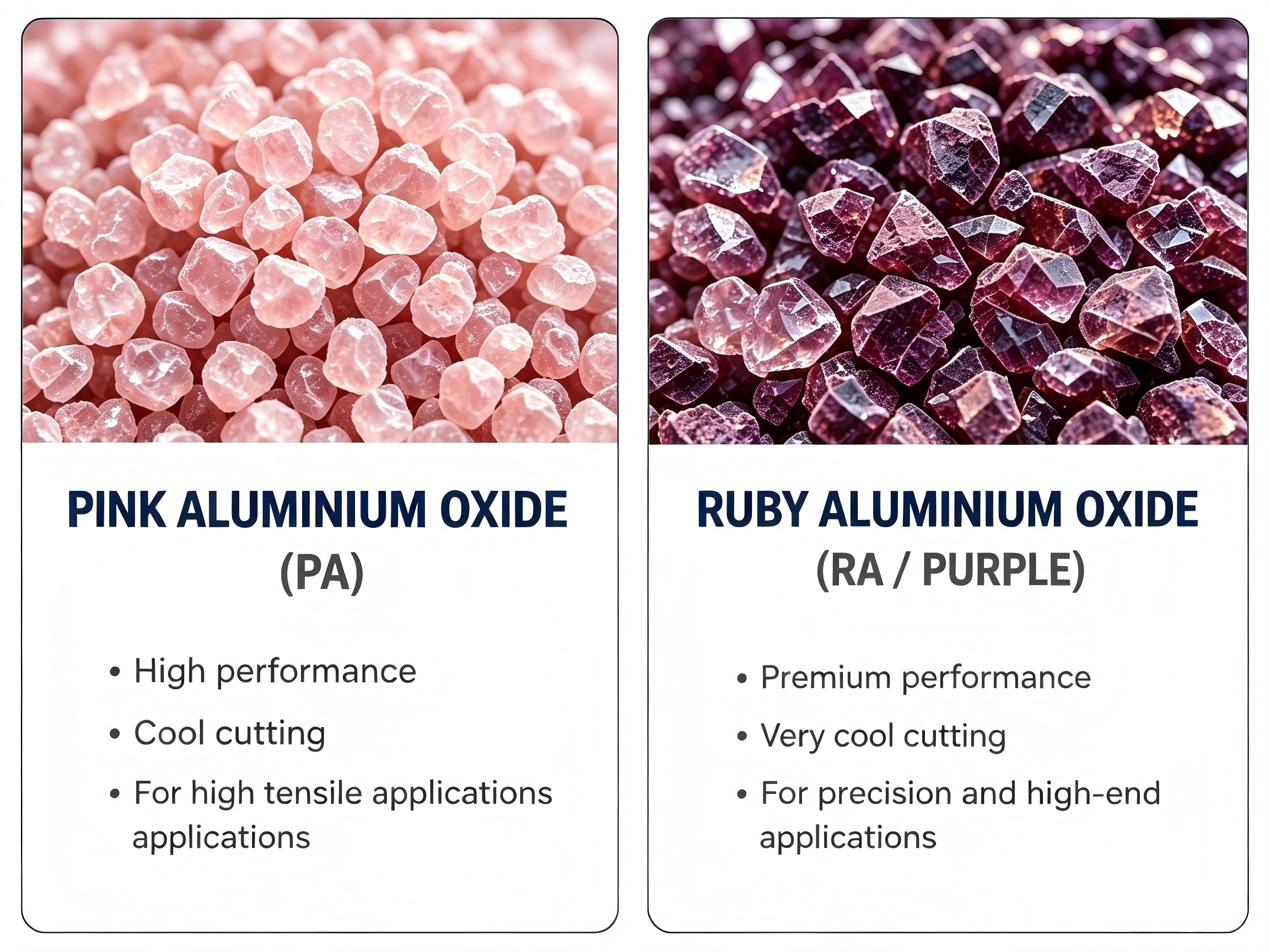
Pink and ruby aluminium oxide are produced by fusing calcined alumina with chromium oxide. The chromium-containing composition changes the colour and also affects grain behaviour.
Pink aluminium oxide combines relatively sharp cutting action with more toughness than standard white aluminium oxide. It is often used in precision grinding and for tool steels or applications requiring controlled cutting and surface quality.
Ruby aluminium oxide normally contains more chromium oxide than lighter pink grades. It is commonly used in vitrified grinding wheels and specialised applications where grain strength and edge renewal are important. Product data from one grain manufacturer, for example, show a higher chromium oxide content in its ruby grade than in its standard pink grade.
Colour alone should not be used to judge performance, because chromium levels and naming systems vary between suppliers.
Ceramic Aluminium Oxide and Seeded Gel Alumina
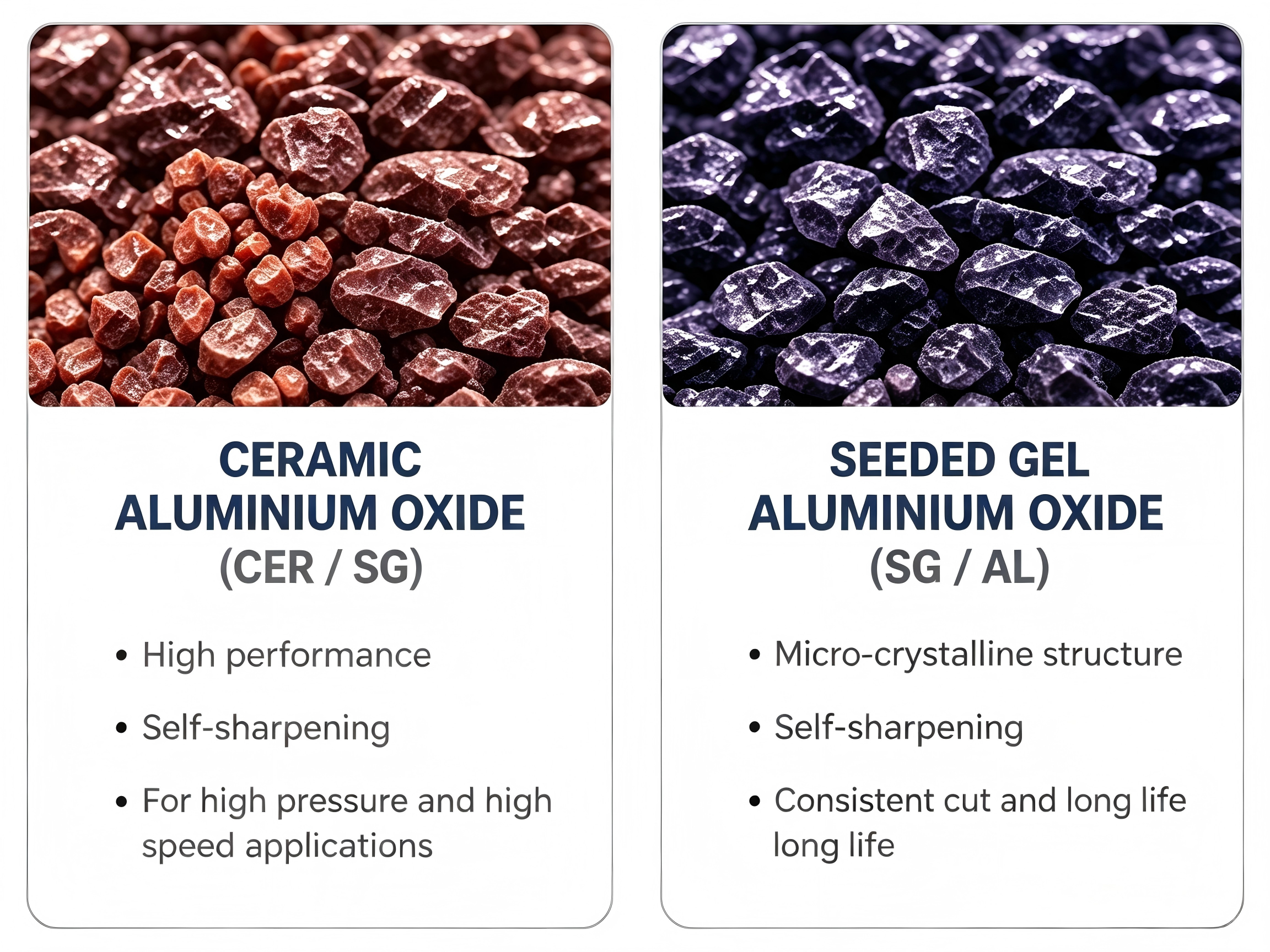
Ceramic aluminium oxide has a fine microcrystalline structure. Under suitable grinding pressure, the grain can microfracture and continually create new cutting edges. A P60 ceramic abrasive may therefore remove material faster and maintain an effective cut longer than a conventional P60 aluminium oxide product.
Ceramic grain still needs suitable power and pressure. Otherwise, its self-sharpening mechanism may not be fully activated.
Seeded gel, often abbreviated as SG, is a technology within the microcrystalline ceramic alumina family. It is produced through a sintering process that creates very fine, uniform crystals. Under grinding force, microfracture exposes fresh cutting edges while reducing the loss of large grain pieces.
SG identifies a technology family rather than one universal performance level. Different seeded-gel products may use different grain shapes, microstructures and formulations for different grinding conditions.
Grain Type Is Only Part of the System
Even when two abrasives use the same grit size and grain type, their performance can still differ.
A coated abrasive is a complete system made from grain, backing and bonding materials. FEPA describes coated abrasives as abrasive grain bonded to backing materials such as paper, cloth, film or vulcanised fibre, normally using resin make and size coats.
Grain shape, coating density, resin strength, backing flexibility and belt-joint design can all affect the result.
Operating conditions matter as well. Machine power, pressure, workpiece material and target finish can all change performance. A premium grain cannot work well if it sheds too early or the backing fails first.
How to Select More Effectively
P80, P120 and P240 are important specifications, but only a starting point. Consider the workpiece, required removal rate or finish, machine power and pressure, and whether the priority is purchase price or cost per finished part.
Brown aluminium oxide can be practical for economical, general-purpose work. White, pink and ruby grades can suit more controlled or specialised grinding. Semi-friable and heat-treated grains offer different balances of cut and durability.
Ceramic and seeded gel grains are most valuable when the machine and application can use their microfracturing behaviour effectively.
Two P80 abrasives can therefore produce very different results. The correct comparison is not based on grit size alone, but on the complete system: grain type, product construction, machine conditions and workpiece requirements.
There is no single “best” abrasive grain for every job. The best result comes from matching the abrasive to the application.
This post is also available in:


Leave a Reply
Want to join the discussion?Feel free to contribute!